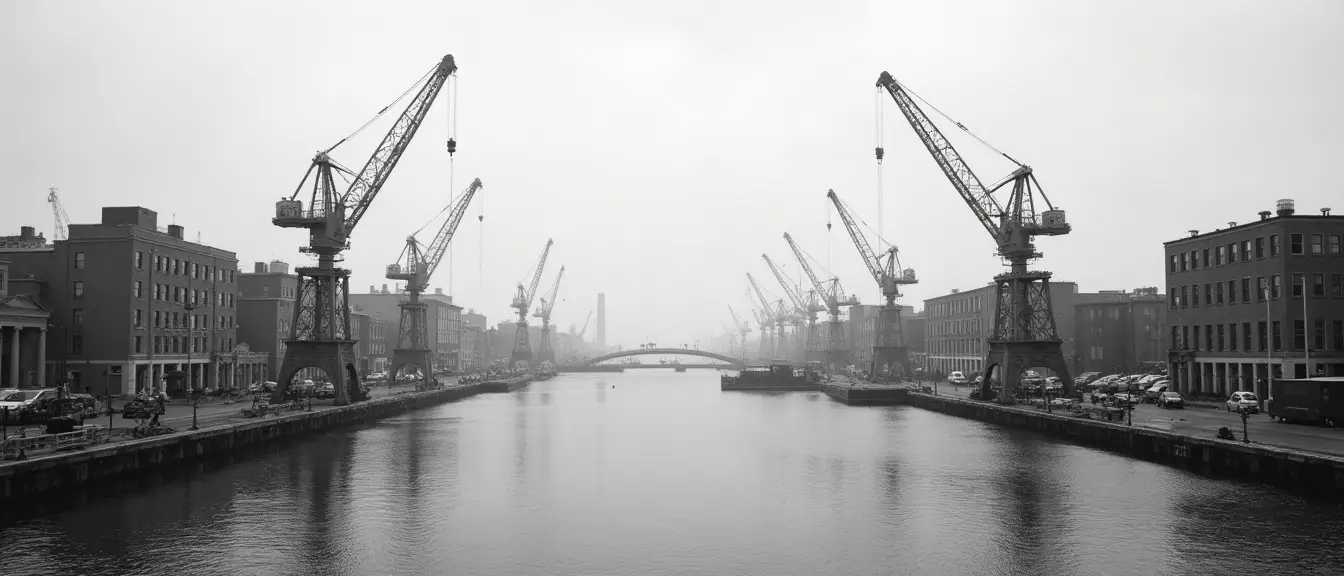
Quick answer: Baltimore's economy hangs on two anchors — a working port that generates freight paperwork the way ports always have, and a medical-institutional complex whose orbit sustains hundreds of small businesses inheriting healthcare's administrative texture. The first builds mirror the anchors: document extraction for everything in the port's supply chains, and intake, scheduling, and billing automation for the practices, agencies, and vendors around the hospital systems. Around them, a rowhouse-city trades economy with old housing stock generating steady service demand, and a professional layer that increasingly serves both Baltimore and Washington — with DC-market expectations arriving alongside DC-market clients.
The port's paper trail
A working port radiates document flows through every business in its orbit: drayage operators and freight brokers managing rate cons and BOLs, customs brokers and forwarders assembling entry paperwork, warehouses reconciling receipts against manifests, and the distributors and manufacturers up the chain re-keying it all into their systems. It's the same extraction-automation case we've made for Georgia and Kansas City — structured documents, relentless volume, entirely manual handling — concentrated in a port city's specific stack. For Baltimore's logistics small businesses, the paperwork build is almost always the first and biggest payback, because the alternative is a back-office headcount that freight margins can't carry.
The medical orbit
Baltimore's world-class medical institutions anchor an economy of their own: specialty and primary-care practices, therapy and imaging groups, home-health and staffing agencies, billing services, medical suppliers, and the facilities contractors serving the campuses. Each inherits the administrative texture we described in the Cleveland guide — insurance verification, prior auths, scheduling that determines utilization, compliance documentation — and each automates along the same seams: reminder and recall systems that keep panels full, intake that completes before the visit, claim-status workflows that stop consuming billing staff, and procurement paperwork for the vendors selling into institutional systems. The confidentiality architecture is standard for us by now: infrastructure you control, data flows you can enumerate, humans owning every judgment call.
Rowhouse trades and two-market professionals
Baltimore's housing stock is old, dense, and constantly in need — a structural demand engine for plumbers, electricians, roofers, and renovation contractors that doesn't depend on boomtown growth. The trades plays are the durable ones: missed-call recovery for the calls that arrive mid-job, estimate follow-up that outlasts the customer's three-bid process, and review engines that compound in neighborhood-by-neighborhood markets where reputation travels by block. Meanwhile the city's professional firms increasingly serve Washington clients at Baltimore cost structures — a genuine arbitrage that only works if the operational tempo matches DC expectations, which is exactly what automated intake, status communication, and follow-up deliver without DC overhead.
How Baltimore businesses work with us
One-time and owned: builds start at $7,500, live in about 30 days, ongoing costs limited to the AI provider at $30–$150 a month paid directly. Everything hands over at launch. Delivery is remote across the metro; see the Baltimore location page and Maryland coverage. The free audit maps where your hours go — port paperwork, practice administration, or a phone that rings on ladders — and ranks the builds by payback on your numbers.
The nonprofit and foundation corridor
Baltimore carries a nonprofit density befitting a city of institutions — community organizations, health and education nonprofits, foundations, and the advocacy layer around them — and these organizations run the small-staff, heavy-admin profile that makes the nonprofit automation playbook land hard: donor acknowledgments, grant reporting calendars, volunteer coordination, program documentation, board communication. Every automated flow returns hours to programs — the metric funders actually evaluate — and the one-time build model fits grant budgets in a way subscriptions structurally don't. A development office whose acknowledgment, reporting, and renewal flows run themselves is a development office that spends its year on relationships instead of paperwork.
The funder-facing payoff is real too: organizations that report cleanly and on time get renewed, and automated grant calendars that prepare documentation ahead of deadlines make on-time the default rather than the sprint. In a city where mission organizations compete for the same regional funders, administrative reliability is quietly a fundraising strategy.
Winter, and a first-90-days plan
Baltimore's rowhouse winters run the emergency-demand pattern of every old northeastern city: cold snaps that burst pipes and fail furnaces block by block, flooding the trades with more calls than any dispatcher triages manually. The emergency-intake build — instant answer, urgency triage, territory booking, human escalation with context — captures the surge that voicemail loses, and for heating and plumbing operators the January weeks it wins pay for the system outright. Run your own winter volumes through the ROI calculator and the seasonal math makes the case without adjectives.
The sequencing that works here mirrors our standard: intake first (bounded, measurable, customer-visible), follow-up and reviews second, and the back-office document flows third — by which point the evidence from builds one and two has replaced faith entirely. Ninety days, three layers, each proven before the next.
Federal spillover, Maryland edition
Baltimore's business economy carries more federal gravity than its reputation suggests — major agencies headquartered across the Maryland suburbs, defense installations ringing the metro, and the contractor-and-vendor layer that follows them all. The firms in that orbit inherit the documentation culture we detail for Fairfax at Baltimore cost structures: externally-imposed reporting formats, compliance calendars, and invoice mappings that automate cleanly precisely because they're rigid. For a Maryland small business, holding one federal-adjacent contract often means running two administrative operations — the commercial one and the compliance one — and workflow automation is how the second stops cannibalizing the first. The same arbitrage logic as the DC-facing professional firms applies: Baltimore overhead, federal-grade administrative tempo, systems bridging the gap.
FAQ
What do Baltimore logistics businesses automate first?
Document extraction: BOLs, rate confirmations, customs paperwork, and carrier invoices flowing into TMS and accounting systems without re-keying. Port-orbit volume is structural, and freight margins can't carry the back-office headcount that manual handling eventually demands. It's consistently the highest-payback build in the harbor economy.
What does AI automation cost?
A typical build is a one-time $7,500, and after launch your only recurring cost is the AI model provider — usually $30–$150 a month, paid directly to them at published rates. No retainer, no subscription, no per-seat fees. How fast it pays back depends on what the manual process costs you today; our ROI calculator runs that arithmetic on your numbers, with the assumptions visible.
Can medical-adjacent businesses automate safely here?
Yes — with the architecture designed for it: systems on infrastructure you control, role-scoped access, logging built in, and data flows short enough to enumerate in a compliance review. Practices automate reminders, recall, and intake; billing and supply businesses automate claims and procurement paperwork — with humans owning every judgment call.
Does serving DC clients change the automation case?
It strengthens it. The Baltimore-cost, DC-client arbitrage only holds if your responsiveness matches what Washington buyers expect — and automated intake, status communication, and follow-up deliver that tempo without hiring at DC rates. The systems are how the arbitrage stays profitable as you scale it.
Who owns the system after the build?
You do — workflows, infrastructure, credentials, and documentation, handed over at launch. We build on open-source tools with your own API keys, so nothing about the system depends on us or on any vendor's continued goodwill. Keep us for maintenance if you want the help; walk away if you don't. It keeps running either way.
How long does a Baltimore build take?
About 30 days end to end, through five phases: Discover, Design, Build, Launch, Optimize. Discovery happens over video, the build runs on infrastructure you control, and training happens with the people who'll actually run the system. Simple builds — a missed-call flow, a review engine — ship in as little as five days. The timeline doesn't change with your industry; port logistics and medical practices run the same phases at the same pace.
A closing thought on sequencing for this market: Baltimore's economy rewards businesses that pick one anchor relationship — a hospital system, a port account, a federal-adjacent contract, a neighborhood — and serve it impeccably. Automation strategy should follow the same shape. Rather than systematizing everything at once, the strongest Baltimore engagements automate the workflow attached to the business's most important relationship first: the paperwork that keeps the anchor account effortless, the intake that captures the neighborhood's referrals, the reporting that keeps the funder renewing. One relationship's administrative layer, fully systematized, proves the model and funds the next — and in a city built on institutional loyalty, being the easiest partner to keep is the most defensible position there is. The audit is where that choice gets made concrete: it maps the hours attached to each relationship, prices the manual versions at your actual rates, and hands you the ranked list — which is a document worth having whether or not a build follows.
Want your Baltimore operation's paperwork mapped and ranked? Get a free automation audit, or start from the Baltimore location page.