Free download · 22 pages
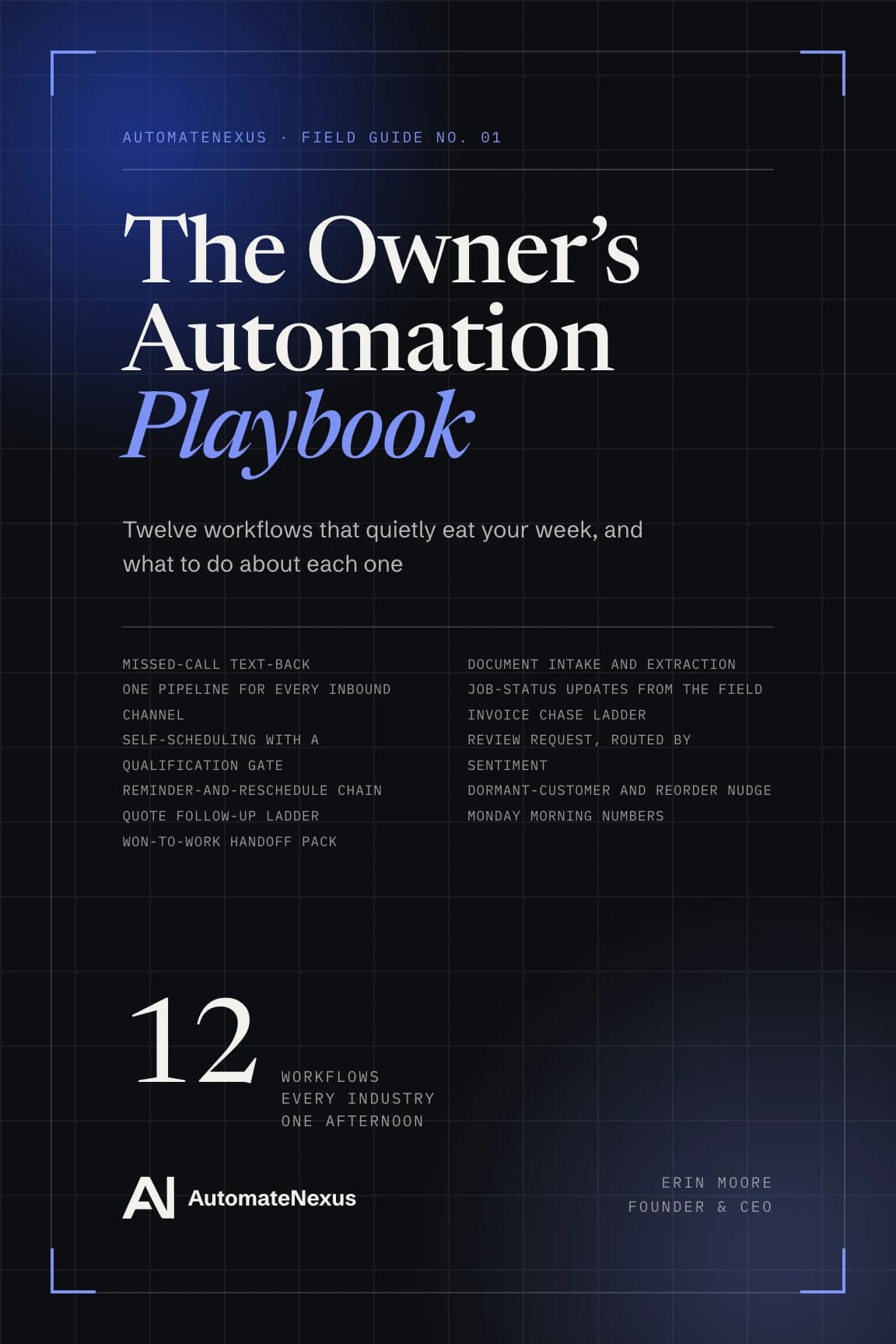
Twelve workflows that quietly eat your week.
Every small business runs the same dozen manual loops — the missed call, the quote nobody chased, the invoice nobody owns, the report somebody rebuilds every Monday. This is each one written out: what starts it, what the automated version does, what it's worth against your own numbers, and when it isn't worth building.
Pages
22
Workflows
12, one page each
Worksheets
Two
Cost
Free, no call
No client stories. No statistics about other companies. Every number in it is one you work out about your own business.
The twelve
You will recognise at least four of these.
Recognising them is the point.
Pick the one that stings most.
/ 01
Missed-call text-back
The call you couldn't take, answered in seconds.
/ 02
One pipeline for every inbound channel
Five inboxes become one queue nobody has to remember.
/ 03
Self-scheduling with a qualification gate
Booking without the dozen messages, and without the wrong calls.
/ 04
Reminder-and-reschedule chain
The 2pm no-show, refilled before it costs you.
/ 05
Quote follow-up ladder
The quote you meant to chase on Thursday.
/ 06
Won-to-work handoff pack
What the salesperson knew, where delivery can see it.
/ 07
Document intake and extraction
Photos, scans and forwards, turned into fields.
/ 08
Job-status updates from the field
Ending the “where are they?” calls.
/ 09
Invoice chase ladder
Somebody owns the chase. It happens every time.
/ 10
Review request, routed by sentiment
Ask the happy ones. Catch the unhappy one first.
/ 11
Dormant-customer and reorder nudge
The customer who quietly stopped buying.
/ 12
Monday morning numbers
The report that builds itself before you wake up.
What's inside
Built to be used, not read.
Two worksheets you fill in.
One decision at the end.
/ 01
The hour audit
A two-page worksheet with ten categories of manual work. Fill in hours per week, apply your own loaded rate, and you have the annual cost of doing it by hand. Your number, not an average from a survey.
/ 02
Twelve workflows, one page each
For every one: what starts it, what it actually does step by step, the building blocks it needs, and how to price it against your own volume. Written so you can recognise your Tuesday in it.
/ 03
A disqualifier on every page
Each workflow carries a plain “skip this if”. Most guides never tell you when not to build something. Reading those twelve lines alone will save you more than the rest of the book.
/ 04
The priority score
Rate each candidate on frequency, time per instance, cost of getting it wrong, and ease of building. The arithmetic picks your first build so you don't pick the most interesting one.
/ 05
A 30-day sequence
Measure and decide, build the narrow version, let it run watched, then prove it and pick the next. Paced for an owner doing this alongside the actual job.
/ 06
The ownership checklist
Nine things to demand from any vendor — credentials in your name, documentation, exports, exit terms. It's written to be used against us as much as anyone else.
Why it's free
None of the twelve is a secret.
Knowing which to build
is free. Building it well
is the work.
Every workflow in this book has been built a thousand times by a thousand companies. Writing them down costs us nothing and might save you a quarter of your week. What is genuinely hard is the part after the diagram: the exceptions, the credentials, the failure alerts, the thing that breaks in month six when an API changes and nobody notices for a fortnight. If you build one yourself from this book, it did its job. If you decide you would rather not, you know where we are.
Questions
Frequently asked questions
What does it cost?
Nothing, and there's no call attached. Your email gets you the PDF immediately plus a private re-download link. We send an occasional automation note afterwards and one click stops it.
Who is it for?
Owners and operators of businesses roughly 2 to 50 people who suspect manual work is eating serious hours and want a structured way to find out where. The twelve workflows recur across trades, clinics, law firms, agencies, e-commerce, restaurants, logistics, accounting and more.
Is it a brochure for your services?
No. The workflows, the math and the checklists work whether you build them yourself, hire someone else, or hire us. There are no client stories and no statistics about other companies in it — every number in the book is one you calculate about your own business.
How long does it take to get through?
The hour audit is about twenty minutes. Reading the twelve and scoring your shortlist is a focused afternoon. You do not have to read it in order — the contents page is built for skipping to the ones that sting.
Do I need technical skills to use it?
No. The workflows are described in terms of what happens and in what order, not in code. The building blocks are named as categories rather than specific products, so the book stays useful whichever tools you already run.
What happens after I download it?
Ideally you build one workflow. If you'd rather see where you stand first, the audit at /free-audit is free and self-serve and takes about three minutes. Builds start at $7,500, fixed in writing before work starts.
What is an example of a business process workflow worth automating?
Lead follow-up. An enquiry arrives by form, call, email or chat; it is acknowledged within minutes, the qualifying questions are asked, a ready-to-buy lead is booked into a real calendar and everyone else enters a helpful sequence, and the record lands in the one system that owns it. Almost no step needs AI — it needs to happen the same way every time, which people are worst at when busy.
Get your copy
Start with the hour audit.
It's on page 3, it takes about twenty minutes, and it decides which of the twelve is worth your time. Everything after that is just execution order.